What Is Answer Engine Optimization (AEO)?
Answer Engine Optimization (AEO) is the process of optimizing content so that search engines, AI assistants, and answer platforms can directly understand and present your information as an answer to users.
Traditional SEO focused mainly on ranking web pages in search results.
AEO focuses on becoming the best direct answer for:
- AI search engines
- Voice assistants
- Featured snippets
- Chatbots
- Generative AI platforms
Examples include:
- Google AI Overviews
- Microsoft Copilot
- OpenAI ChatGPT
- Perplexity AI
- Voice assistants like Siri and Alexa
Difference Between SEO and AEO
| SEO | AEO |
|---|---|
| Focuses on ranking pages | Focuses on answering questions |
| Optimizes for keywords | Optimizes for user intent |
| Targets SERPs | Targets AI answers/snippets |
| Click-focused | Answer-focused |
| Blue links | Conversational responses |
Traditional SEO asks:
“How do I rank #1?”
AEO asks:
“How do I become the answer?”
Why AEO Is Important in 2026
Search behavior is changing rapidly.
Users increasingly ask:
- Conversational questions
- Voice searches
- AI chatbot queries
- Long-tail informational queries
Instead of typing:
“best SEO tools”
Users now ask:
“What are the best SEO tools for small businesses in India?”
AI systems try to give direct answers instantly.
That means businesses must optimize content not only for rankings but also for AI understanding.
How Answer Engines Work
Answer engines use:
- Natural Language Processing (NLP)
- Machine learning
- Knowledge graphs
- Semantic search
- Entity understanding
They analyze:
- Content quality
- Expertise
- Context
- Structured data
- Relevance
- User intent
Then they generate summarized answers.
Key Elements of AEO
1. Question-Based Content
AEO content should answer real user questions clearly.
Examples:
- What is SEO?
- How does technical SEO work?
- Is India safe for family travel?
- What are backlinks?
FAQ-style formatting works very well.
2. Clear and Concise Answers
Answer engines prefer:
- Direct answers
- Simple language
- Short explanations first
- Detailed explanation afterward
Example Structure
- Short definition
- Expanded explanation
- Examples
- Supporting details
3. Structured Content
Well-organized content helps AI systems understand pages better.
Use:
- H1, H2, H3 headings
- Bullet points
- Tables
- Lists
- FAQs
- Step-by-step formatting
4. Semantic SEO
Modern search engines understand meaning, not just keywords.
AEO relies heavily on:
- Topic relevance
- Context
- Related concepts
- Entity relationships
Example:
A page about SEO should naturally mention:
- Keywords
- Search intent
- Backlinks
- Technical SEO
- Content optimization
5. Schema Markup
Structured data helps answer engines interpret content.
Useful schema types:
- FAQ schema
- How-to schema
- Article schema
- Product schema
- Local business schema
Schema increases the chance of:
- Rich snippets
- AI extraction
- Voice assistant usage
6. E-E-A-T Optimization
Answer engines prioritize trustworthy content.
Google emphasizes:
- Experience
- Expertise
- Authoritativeness
- Trustworthiness
Websites with strong credibility perform better in AEO.
Types of Content That Perform Well in AEO
FAQs
Very effective for conversational searches.
How-To Guides
Step-by-step tutorials are highly AI-friendly.
Definitions
Simple explanations often become featured snippets.
Comparisons
Examples:
- SEO vs PPC
- AEO vs SEO
- On-page vs off-page SEO
Lists
Examples:
- Top SEO tools
- Best family destinations in India
- Common SEO mistakes
AEO and Voice Search
Voice assistants rely heavily on answer optimization.
Voice searches are usually:
- Longer
- Conversational
- Question-based
Example:
Typed search:
“weather Delhi”
Voice search:
“What’s the weather like in Delhi today?”
AEO helps content appear in spoken search responses.
AEO and AI Search Engines
AI-powered search systems summarize information from multiple sources.
To improve visibility:
- Write factually accurate content
- Use clear formatting
- Build authority
- Add citations and statistics
- Maintain updated information
AI systems prefer content that is:
- Trustworthy
- Easy to parse
- Comprehensive
- Helpful
How to Optimize for Answer Engines
Focus on Search Intent
Understand what users actually want.
Intent types:
- Informational
- Navigational
- Commercial
- Transactional
Use Conversational Language
Write naturally like humans speak.
Example:
Instead of:
“Best SEO methodology implementation”
Use:
“What are the best SEO strategies?”
Add FAQ Sections
FAQ blocks increase answer visibility.
Example:
What is technical SEO?
How long does SEO take?
Are backlinks still important?
Optimize Featured Snippets
Google often pulls concise definitions into featured snippets.
Best practices:
- Answer within 40–60 words
- Use lists and tables
- Define terms clearly
Build Topical Authority
Cover topics comprehensively.
Example:
An SEO website should include:
- Technical SEO
- Content SEO
- Local SEO
- Link building
- AI SEO
- AEO
- Semantic SEO
Improve Technical SEO
Answer engines still rely on strong technical foundations:
- Fast loading speed
- Mobile optimization
- Crawlability
- HTTPS security
- Clean site architecture
AEO in India
AEO is becoming increasingly important in India because:
- Mobile usage is massive
- Voice search is growing rapidly
- AI search adoption is increasing
- Regional language searches are expanding
Indian businesses can benefit greatly from:
- FAQ content
- Conversational SEO
- Hindi and multilingual optimization
- Localized answer content
Industries seeing strong AEO growth include:
- Travel
- Healthcare
- Education
- Finance
- SEO services
- eCommerce
Is SEO Dead Because of AEO?
No. SEO and AEO now work together.
SEO helps content get discovered.
AEO helps content become the direct answer.
Modern optimization combines:
- SEO
- AEO
- Semantic search
- Entity optimization
- Brand authority
- User experience
Conclusion
Answer Engine Optimization (AEO) is the next evolution of SEO. Instead of optimizing only for rankings, AEO focuses on helping AI systems and search engines understand, extract, and present your content as the best possible answer.
As AI-driven search grows in India and globally, businesses that create clear, trustworthy, structured, and question-focused content will gain major visibility advantages.
In 2026 and beyond, successful digital marketing strategies will increasingly combine:
- Traditional SEO
- Semantic optimization
- AI-friendly content
- Conversational search optimization
- Authority building
The future of search is not only about being found—it is about being chosen as the answer.
🔍 1. SEO (Search Engine Optimization)
This is the foundation.
SEO = optimizing your website so it ranks on search engines like Google.
Core parts:
- On-page SEO → keywords, content, headings
- Off-page SEO → backlinks
- Technical SEO → speed, mobile, indexing
Goal:
👉 Rank higher on Google search results
👉 Get organic traffic
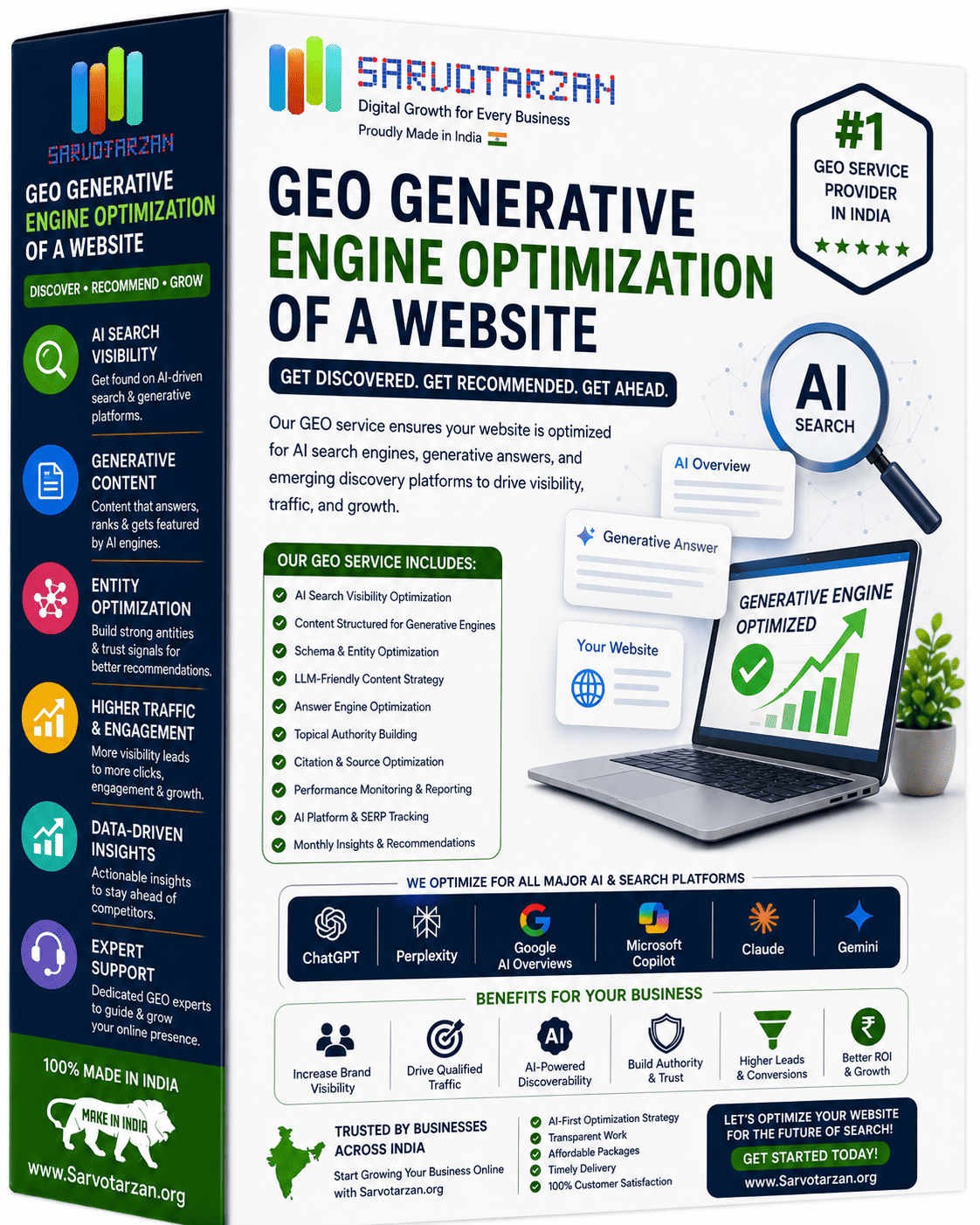
📍 2. GEO (Generative Engine Optimization)
This is new-age SEO for AI-driven answers.
GEO = optimizing your content so AI tools like ChatGPT, Google Gemini, and Microsoft Copilot pick your content in their answers.
How it works:
AI doesn’t just rank websites — it extracts answers.
So you optimize for:
- Direct answers (clear, structured content)
- FAQs
- Authority (E-E-A-T)
- Citations & mentions across web
Example:
Instead of writing:
“SEO is important…”
You write:
“SEO typically takes 3–6 months to show results depending on competition.”
👉 This gets picked by AI answers.
🤖 3. AIO (AI Optimization / AI Integration Optimization)
This is broader than GEO.
AIO = optimizing your entire digital presence for AI-driven platforms + automation
Includes:
- GEO (AI content optimization)
- AI chatbots on website
- Personalized AI funnels
- AI-driven ad targeting
- Content automation
Goal:
👉 Not just traffic
👉 But conversion using AI
⚔️ SEO vs GEO vs AIO (Simple View)
| Factor | SEO | GEO | AIO |
|---|---|---|---|
| Focus | Google ranking | AI answers | AI ecosystem |
| Traffic source | Search results | AI tools | Multi-channel |
| Strategy | Keywords | Answers + authority | Automation + AI |
| Future relevance | High | Very high | Explosive |
💡 Practical Strategy (for YOU)
Since you’re already into SEO services, here’s the real opportunity:
1. Combine SEO + GEO
- Write blog posts
- Add FAQ sections
- Use question-based headings
2. Target AI queries
People now ask:
- “Best SEO services in India?”
- “SEO kitne time me result deta hai?”
👉 Create content answering these EXACTLY.
3. Build “AI-friendly authority”
- Publish case studies
- Get brand mentions
- Use structured data
4. Sell it as a service 💰
You can literally create a new package:
“AI SEO / GEO Package”
- AI-optimized content
- FAQ schema
- Featured snippet targeting
- AI visibility tracking
👉 Price it higher than normal SEO (less competition right now)
🚀 Reality Check
If you ignore GEO/AIO:
👉 You’ll rank on Google
👉 But lose traffic to AI answers
If you adopt early:
👉 You become the source AI pulls from
📍 GEO (Generative Engine Optimization) – The Future of Search in 1000 Words
Generative Engine Optimization (GEO) is the next evolution of digital visibility, emerging alongside the rapid rise of artificial intelligence tools like ChatGPT, Google Gemini, and Microsoft Copilot. While traditional Search Engine Optimization (SEO) focuses on ranking websites on search engines like Google, GEO is about optimizing content so that it gets selected, cited, and surfaced directly inside AI-generated answers.
This shift is fundamental. Instead of users clicking on blue links, they increasingly receive direct, conversational responses from AI systems. As a result, businesses must rethink how they create and structure content to remain visible in this new landscape.
🔍 What is GEO?
GEO refers to the process of designing and structuring digital content so that generative AI systems can easily understand, extract, and present it as part of their answers. Unlike SEO, where ranking position determines visibility, GEO is about being the source of truth that AI models rely on.
For example, when a user asks an AI tool, “How long does SEO take to show results?”, the AI doesn’t display ten website links. Instead, it generates a summarized answer based on multiple sources. GEO ensures that your content is one of those sources.
⚙️ How GEO Works
AI systems use large language models (LLMs) trained on vast datasets. They retrieve, synthesize, and generate responses by identifying high-quality, relevant, and trustworthy information.
To be selected, your content must meet certain criteria:
1. Clarity and Directness
AI prefers content that answers questions clearly and concisely. अस्पष्ट या लंबा घुमावदार content कम उपयोगी होता है.
2. Structured Information
Well-organized content with headings, bullet points, and FAQs is easier for AI to parse.
3. Authority and Trust (E-E-A-T)
Content that demonstrates Experience, Expertise, Authority, and Trustworthiness is more likely to be used.
4. Contextual Relevance
AI selects content that best matches the intent behind a query, not just keywords.
🧠 GEO vs Traditional SEO
While GEO and SEO overlap, they differ in key ways:
- SEO focuses on rankings; GEO focuses on answer inclusion
- SEO targets search engines; GEO targets AI models
- SEO relies heavily on keywords; GEO relies on meaning and context
- SEO drives clicks; GEO may reduce clicks but increase brand authority
This doesn’t mean SEO is obsolete. Instead, GEO builds on SEO. A strong SEO foundation increases the chances of your content being discovered and used by AI systems.
✍️ Key Strategies for GEO
To succeed with GEO, content creators and businesses must adapt their approach. Here are the most effective strategies:
1. Write for Questions, Not Just Keywords
Modern users interact with AI conversationally. Instead of targeting “SEO services India,” target questions like:
- “What are the best SEO services in India?”
- “How much does SEO cost in Delhi?”
Answer these questions directly within your content.
2. Use FAQ Sections
FAQ sections are extremely valuable for GEO. They provide clear, structured answers that AI can easily extract.
Example:
Q: How long does SEO take?
A: SEO typically takes 3 to 6 months to show measurable results, depending on competition and website quality.
3. Provide Precise, Data-Driven Answers
Avoid vague statements. AI prefers specificity.
Weak:
SEO takes time.
Strong:
SEO usually takes 90–180 days to deliver noticeable ranking improvements.
4. Build Topical Authority
Instead of writing random blogs, focus on becoming an authority in a niche. Cover all related topics deeply.
For example, if your niche is SEO:
- On-page SEO
- Off-page SEO
- Technical SEO
- Local SEO
- AI SEO (GEO)
This creates a strong knowledge graph around your website.
5. Optimize for Featured Snippets
Featured snippets often serve as training signals for AI models. Structuring content to win snippets improves GEO performance.
Use:
- Lists
- Tables
- Step-by-step guides
6. Strengthen Brand Mentions
AI doesn’t just rely on your website. It looks at your presence across the web. Mentions on blogs, directories, and social platforms increase credibility.
7. Use Structured Data (Schema Markup)
Schema helps search engines and AI systems understand your content better. FAQ schema, article schema, and local business schema are especially useful.
📊 Benefits of GEO
1. Visibility in AI Answers
Your content can appear directly in AI-generated responses, even if you’re not ranking #1 on Google.
2. Higher Authority
Being cited by AI tools builds trust and brand recognition.
3. Future-Proof Strategy
As AI adoption grows, GEO will become essential for digital success.
⚠️ Challenges of GEO
1. Reduced Click Traffic
Users may get answers without visiting your website.
2. Less Control
AI decides how your content is summarized and presented.
3. Measurement Difficulty
Tracking GEO performance is still evolving compared to traditional SEO metrics.
🚀 GEO in India and Local Markets
In markets like India, where mobile usage and voice search are growing rapidly, GEO has massive potential. Users often ask questions in natural language or Hinglish, such as:
- “SEO kitne time me result deta hai?”
- “Best digital marketing agency near me?”
Creating content that matches these patterns increases your chances of being selected by AI tools.
💼 Business Opportunity
For agencies and freelancers, GEO opens a new revenue stream. You can package it as:
“AI SEO Services” or “GEO Optimization”
- AI-friendly content writing
- FAQ optimization
- Authority building
- AI visibility tracking
Since competition is still low, pricing can be premium compared to traditional SEO services.
🔮 The Future of GEO
The future of search is shifting from “search and click” to “ask and receive.” AI tools will increasingly act as intermediaries between users and information.
Companies that adapt early will:
- Gain disproportionate visibility
- Build stronger authority
- Capture high-intent audiences
Those who rely only on traditional SEO risk losing relevance as AI becomes the primary interface for information discovery.
🧾 Conclusion
Generative Engine Optimization (GEO) is not just a trend—it is a fundamental shift in how information is discovered and consumed. By focusing on clarity, structure, authority, and user intent, businesses can position themselves as trusted sources in AI-generated answers.
Rather than replacing SEO, GEO enhances it. Together, they form a powerful strategy for the future of digital marketing. The key is to start early, experiment, and continuously refine your approach as AI technologies evolve.
If done right, GEO doesn’t just bring traffic—it makes your brand the answer.